
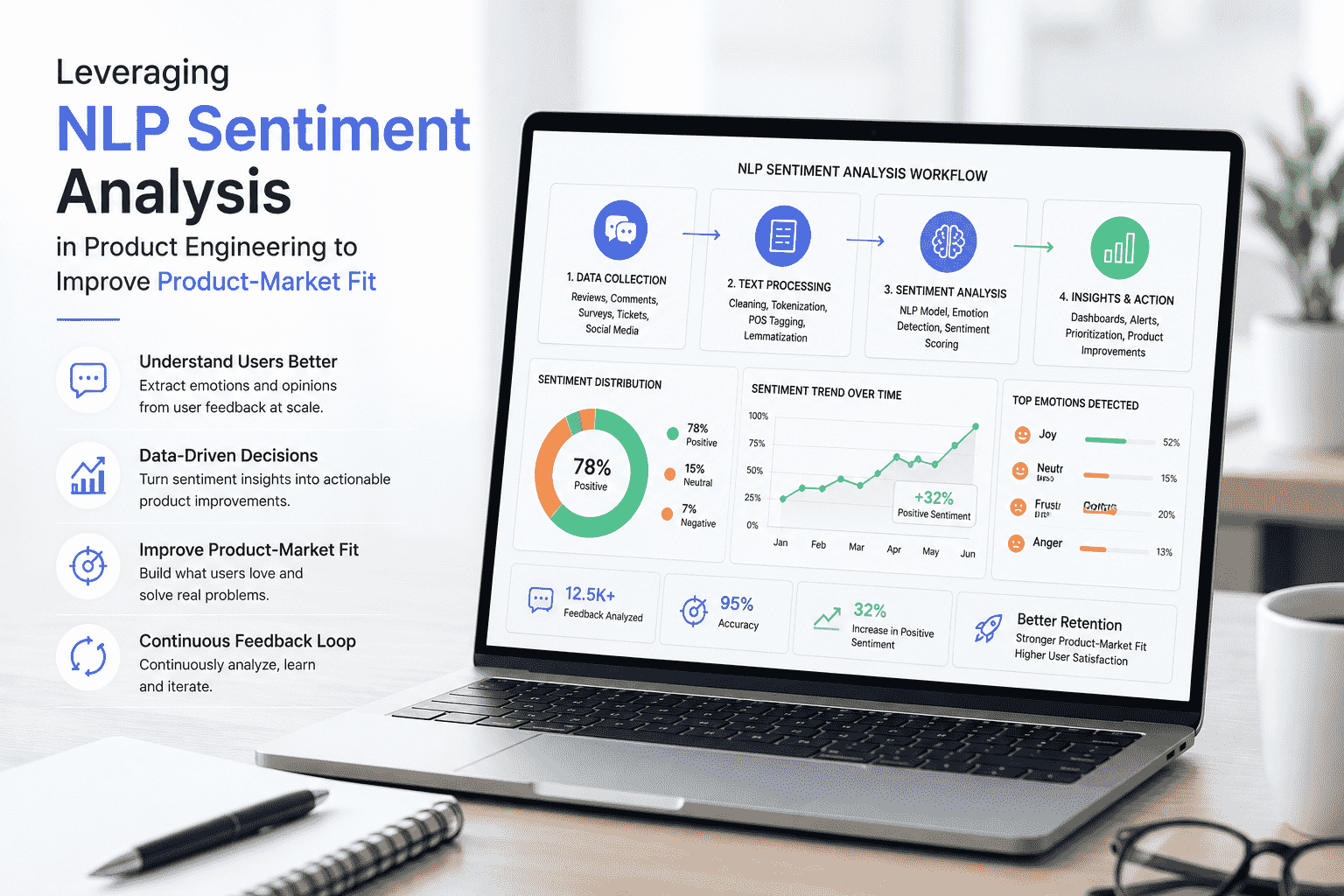
Leveraging NLP Sentiment Analysis in Product Engineering to Improve Product-Market Fit
Modern digital products succeed when they align closely with user expectations, emotions, and behavior patterns.
Enterprises today use NLP sentiment analysis to interpret customer opinions hidden within reviews, feedback forms, chat conversations, and social media discussions. Instead of depending solely on traditional analytics, engineering teams now integrate intelligent language understanding into their product strategies to improve engagement, usability, and long-term adoption.
According to recent industry insights, around 74% of organizations use sentiment analysis tools for monitoring customer opinions across digital platforms, reflecting how critical language intelligence has become in shaping product decisions.
This rapid adoption demonstrates the growing importance of natural language processing services and predictive analytics in product engineering workflows.
By combining advanced AI technologies with modern web and application development, companies can transform unstructured feedback into meaningful insights that guide innovation. As businesses strive to achieve better product-market fit, integrating sentiment analysis into engineering processes helps bridge the gap between customer expectations and technical execution.
This blog uncovers how enterprises can leverage NLP-driven sentiment intelligence to build smarter products and drive sustainable growth.
What is NLP Sentiment Analysis?
NLP sentiment analysis refers to the process of using artificial intelligence to evaluate the emotional tone behind text data. It helps organizations classify user opinions as positive, negative, or neutral while identifying deeper contextual meaning.
By leveraging natural language processing services, enterprises can analyze massive volumes of feedback quickly and accurately, enabling faster decision-making across product engineering teams. Unlike traditional analytics that focus on numerical data, sentiment analysis interprets human language patterns to uncover behavioral insights.
When combined with predictive analytics, sentiment intelligence helps companies forecast future user reactions and anticipate product performance trends. This makes sentiment analysis an essential capability for organizations seeking to create user-centric digital experiences and continuously refine product strategies.
How NLP Sentiment Analysis Proves Helpful in Product Engineering?
Integrating NLP sentiment analysis into product engineering enables organizations to align development priorities with real user expectations. By analyzing feedback at scale, engineering teams can uncover pain points, validate feature ideas, and improve user experiences.
When combined with modern web and application development, sentiment-driven insights help teams deliver products that resonate effectively with target audiences. Here’s how NLP sentiment analysis proves helpful in product engineering:
Identifying User Pain Points Quickly
Sentiment analysis helps engineering teams detect recurring issues in user feedback, allowing faster resolution of product challenges. By leveraging natural language processing services, developers can prioritize critical improvements and reduce the time required to respond to customer dissatisfaction.
Improving Feature Prioritization
Engineering teams often struggle to determine which features deliver the most value. Sentiment analysis provides data-driven clarity by highlighting user preferences and emotional responses. With support from advanced analytics tools, product managers can make strategic decisions that align with market demands.
Automating Feedback Analysis with Agentic AI
Emerging technologies like agentic AI allow enterprises to automate the monitoring of sentiment trends. Intelligent systems can analyze conversations in real time, identify negative sentiment spikes, and recommend corrective actions, enabling engineering teams to respond proactively to potential product issues.
Enhancing User Experience Design
When teams analyze emotional feedback patterns, they gain insights into how users interact with interfaces. Integrating web and application development strategies with sentiment insights allows designers to create intuitive layouts, smoother navigation flows, and personalized experiences that improve overall product satisfaction.
Supporting Predictive Product Decisions
By combining sentiment intelligence with predictive analytics, organizations can forecast how users might react to future updates. This approach reduces uncertainty during product planning and helps teams release features that align with evolving customer expectations.
Strengthening Customer Retention Strategies
Sentiment-driven insights help organizations understand why users stay loyal or abandon products. By continuously monitoring feedback patterns, enterprises can refine engagement strategies, enhance product value, and create stronger connections with their audience.
Best Practices for Using NLP Sentiment Analysis to Improve Product-Market Fit
To maximize the impact of NLP sentiment analysis, organizations must integrate it strategically within product engineering workflows. Successful implementation requires a balance between advanced technology, structured processes, and human expertise to ensure insights translate into meaningful product improvements.
The following are some best using NLP sentiment analysis to improve product-market fit:
Align Sentiment Data with Business Goals
Engineering teams should map sentiment insights directly to business objectives such as retention, usability, or conversion rates. Using natural language processing services, organizations can transform feedback into measurable performance indicators that guide development priorities.
Combine Quantitative and Qualitative Insights
Relying solely on sentiment scores can limit understanding. Integrating emotional analysis with behavioral metrics helps teams gain a complete view of user experiences, ensuring that product decisions remain data-driven and context-aware.
Build Real-Time Feedback Pipelines
Continuous monitoring allows organizations to capture sentiment shifts instantly. By integrating feedback systems within web and application development environments, teams can respond quickly to emerging trends and maintain product relevance.
Train Models on Domain-Specific Data
Customized NLP models deliver more accurate results when trained on industry-specific terminology. This approach improves contextual understanding and ensures sentiment analysis reflects real-world customer expectations.
Integrate Predictive Analytics for Strategic Planning
Combining predictive analytics with sentiment intelligence helps organizations anticipate market trends. Engineering teams can test product ideas before launch, reducing risk and improving the chances of achieving strong product-market fit.
Maintain Ethical AI Governance
Transparency and fairness are essential when using sentiment analysis. Organizations must implement monitoring systems that prevent bias and ensure responsible AI usage across enterprise environments.
Use Agentic AI for Continuous Optimization
Adopting agentic AI enables automated monitoring and improvement of sentiment-driven workflows. Intelligent systems can recommend feature enhancements, identify anomalies, and streamline decision-making processes for engineering teams.
Encourage Cross-Functional Collaboration
Successful sentiment-driven strategies require collaboration between developers, designers, marketers, and analysts. Aligning technical insights with business strategies ensures that product improvements reflect both user needs and organizational goals.
Mistakes to Avoid When Using NLP Sentiment Analysis in Product Engineering
Implementing NLP sentiment analysis without a clear strategy can lead to inaccurate insights and poor product decisions. Enterprises must avoid common pitfalls that limit the effectiveness of sentiment-driven product engineering.
Businesses must avoid the following mistakes when using NLP sentiment analysis:
Ignoring Contextual Nuances: Overlooking language context reduces accuracy and weakens sentiment insights generated through natural language processing.
Relying Solely on Automated Decisions: Excessive dependence on AI without human oversight can misinterpret emotional intent and user expectations.
Neglecting Data Quality: Poorly structured datasets reduce the effectiveness of predictive analytics and sentiment modeling accuracy significantly.
Failing to Update Models Regularly: Outdated models struggle to interpret evolving language patterns, slang, or emerging market trends effectively.
Overlooking Integration with Development Workflows: Separating sentiment tools from development processes limits their practical impact on products.
Conclusion
Leveraging NLP sentiment analysis within product engineering empowers organizations to create products that truly resonate with users. By transforming unstructured feedback into actionable insights, enterprises can refine development strategies, improve customer satisfaction, and achieve stronger alignment between product capabilities and market expectations.
As businesses continue adopting advanced technologies, sentiment-driven engineering will become a cornerstone of innovation. When combined with modern web and application development practices, NLP-powered insights enable organizations to build adaptive, user-focused products that evolve alongside changing market dynamics and deliver sustainable competitive advantages.