
Mobile App Development
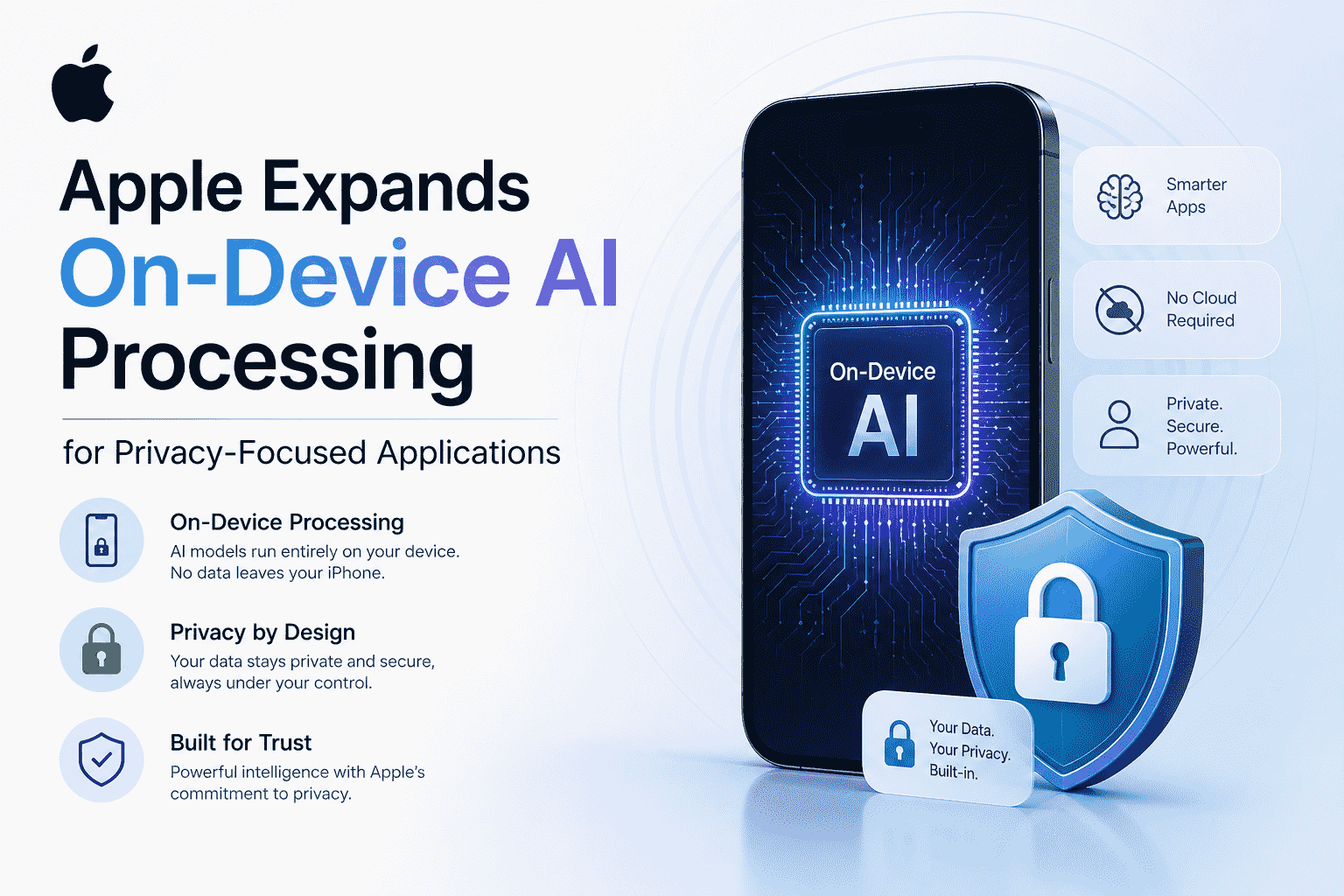
Apple Expands On-Device AI Processing for Privacy-Focused Applications
May 29, 20266 min read
As the demand for smarter digital experiences continues to grow, users are becoming increasingly concerned about how their personal information is collected, stored, and processed. Apple has responded to these concerns by expanding its on-device AI capabilities, allowing more intelligent features to operate directly on user devices rather than relying heavily on cloud-based infrastructure. This shift represents a major step forward for Privacy-Focused Applications, enabling advanced functionality while maintaining stronger control over sensitive data.
The evolution of Artificial Intelligence has transformed how people interact with technology. However, many AI-powered services require large amounts of user data to be sent to external servers for processing. Apple’s latest advancements aim to reduce this dependency, creating a more secure and privacy-conscious AI ecosystem that aligns with growing consumer expectations and regulatory requirements.
Understanding Apple's On-Device AI Strategy
On-device AI refers to the process of running machine learning models directly on smartphones, tablets, laptops, and other hardware rather than transmitting data to cloud servers. Apple has steadily invested in specialized silicon, neural processing units, and optimized software frameworks that make this approach possible. The company’s strategy focuses on balancing intelligence, efficiency, and privacy. By keeping more computations on the device, users can access advanced features such as voice recognition, image analysis, predictive text, and personalized recommendations without exposing large amounts of personal information to external systems. This approach differs from traditional AI architectures that often require continuous cloud communication. Instead, Apple aims to process data locally whenever possible, ensuring faster response times and greater user trust.Why Privacy Matters in Modern AI Development
The rapid adoption of AI technologies has introduced new concerns surrounding data security and privacy. Every digital interaction generates information that can potentially be collected, analyzed, and stored. While cloud-based AI systems provide significant computational power, they also create additional risks related to data transmission and centralized storage. Organizations worldwide are increasingly prioritizing privacy as a competitive advantage. Consumers now expect technology providers to implement stronger safeguards around personal information, particularly when AI systems are involved. Apple's focus on on-device processing demonstrates how privacy and innovation can coexist. Instead of viewing privacy as a limitation, the company positions it as a foundational element of AI development. This philosophy has become increasingly important as governments introduce stricter data protection regulations across multiple regions.How Apple's Hardware Supports Advanced AI Processing
A key factor behind Apple’s on-device AI expansion is its custom silicon architecture. Modern Apple chips include dedicated neural engines capable of performing billions of machine learning operations per second while maintaining energy efficiency. These specialized processors enable AI tasks such as:- Real-time language understanding
- Image and video recognition
- Predictive user assistance
- Context-aware recommendations
- Voice command processing
Privacy-Focused Applications and the Future of Mobile Intelligence
The Growing Importance of Privacy-Focused Applications
The expansion of Privacy-Focused Applications marks an important shift in the broader technology landscape. Rather than collecting extensive amounts of user information for centralized analysis, these applications are designed to process data locally whenever possible. This approach benefits both consumers and businesses. Users gain greater confidence in how their information is handled, while organizations can reduce compliance risks associated with data storage and transmission. Examples of privacy-centered AI experiences include intelligent personal assistants, health monitoring systems, smart photography tools, and productivity applications that operate with minimal data sharing. As on-device AI capabilities become more sophisticated, developers will have greater opportunities to build innovative solutions that prioritize user trust from the beginning.The Impact on Developers and AI Innovation
Apple’s advancements are expected to influence how developers design future applications. Rather than relying entirely on cloud infrastructure, development teams may increasingly optimize AI models for local execution. This trend could reshape several areas of the technology industry, including solutions traditionally associated with AI and Machine Learning Services. Businesses may begin prioritizing architectures that combine strong performance with privacy-preserving design principles. The move toward local intelligence also encourages developers to build more efficient models. Smaller, optimized AI systems can reduce resource consumption while still delivering meaningful results for users. As hardware capabilities continue to improve, on-device processing may become a standard requirement for many next-generation applications.Benefits for Enterprise and Consumer Users
The expansion of on-device AI offers advantages that extend beyond privacy alone. Both individuals and organizations can benefit from improved performance, reliability, and security. For consumers, local AI processing often means faster interactions and greater responsiveness. Tasks can be completed immediately without waiting for data to travel to and from remote servers. For enterprises, on-device AI can support compliance initiatives by reducing the amount of sensitive information transmitted across networks. This is particularly relevant in industries such as healthcare, finance, and legal services, where data protection requirements are especially strict. Organizations exploring advanced technologies such as Generative AI Development Services may also find value in incorporating privacy-preserving techniques into their broader AI strategies.The Role of Language and Context Understanding
One area where Apple continues to invest heavily is language intelligence. Modern AI systems are increasingly expected to understand context, intent, and conversational nuances. Advancements in Natural Language Processing Services have made it possible for devices to interpret user requests more accurately while delivering personalized responses. Running these capabilities directly on a device helps ensure that sensitive conversations remain private and secure. As language models become more sophisticated, local processing will play an important role in maintaining trust while enabling richer user experiences.Industry-Wide Implications of Apple's Approach
Apple's decisions often influence broader technology trends, and its commitment to on-device AI is likely to encourage similar investments across the industry. Competitors may accelerate efforts to create privacy-conscious AI solutions that reduce reliance on centralized cloud processing. This shift could also impact organizations offering AI Strategy Consulting Services, as businesses seek guidance on integrating privacy-first principles into their AI roadmaps. Furthermore, emerging technologies such as Agentic AI Development Services may increasingly incorporate local decision-making capabilities, enabling autonomous systems to operate more securely and efficiently. The growing emphasis on privacy may also drive demand for Intelligent Automation Services that can perform complex workflows while minimizing data exposure. At a broader organizational level, privacy-centered AI initiatives are expected to become a critical component of long-term AI Transformation Services, helping companies modernize operations without sacrificing user trust.Challenges and Limitations of On-Device AI
Despite its advantages, on-device AI is not without challenges. Local processing requires significant computational resources, and some advanced AI models remain too large to run efficiently on consumer hardware. Developers must balance performance, battery life, storage requirements, and processing power when designing AI experiences. Additionally, certain applications may still require cloud support for tasks involving extensive datasets or complex computations. However, ongoing improvements in chip design, model optimization, and machine learning frameworks continue to reduce these limitations. As technology evolves, the capabilities of on-device AI are expected to expand significantly.Conclusion
Apple’s expansion of on-device AI processing represents a meaningful advancement in the evolution of intelligent technology. By shifting more AI workloads directly onto user devices, the company is addressing growing concerns surrounding privacy, security, and data ownership while delivering faster and more responsive experiences. The future of Privacy-Focused Applications will likely be shaped by innovations that prioritize both intelligence and trust. As users demand greater transparency and stronger data protection, on-device AI provides a compelling framework for balancing technological advancement with responsible privacy practices. Apple's continued investment in this area signals a broader industry movement toward AI systems that empower users without requiring them to sacrifice control over their personal information.Related Articles
 Mobile App Development
How APIs Play a Key Role in Front End App Development
Jul 26 min read Mobile App Development
Product-Market Fit Through Agile Execution by a Startup Web App Development Company
Jul 26 min read Mobile App Development
Core Technologies Driving a Custom Mobile App Development Company’s Innovation Process
Jun 266 min read Mobile App Development
Essential Tech Stack Behind the Best Healthcare App Development Company’s Success
Jun 256 min read