
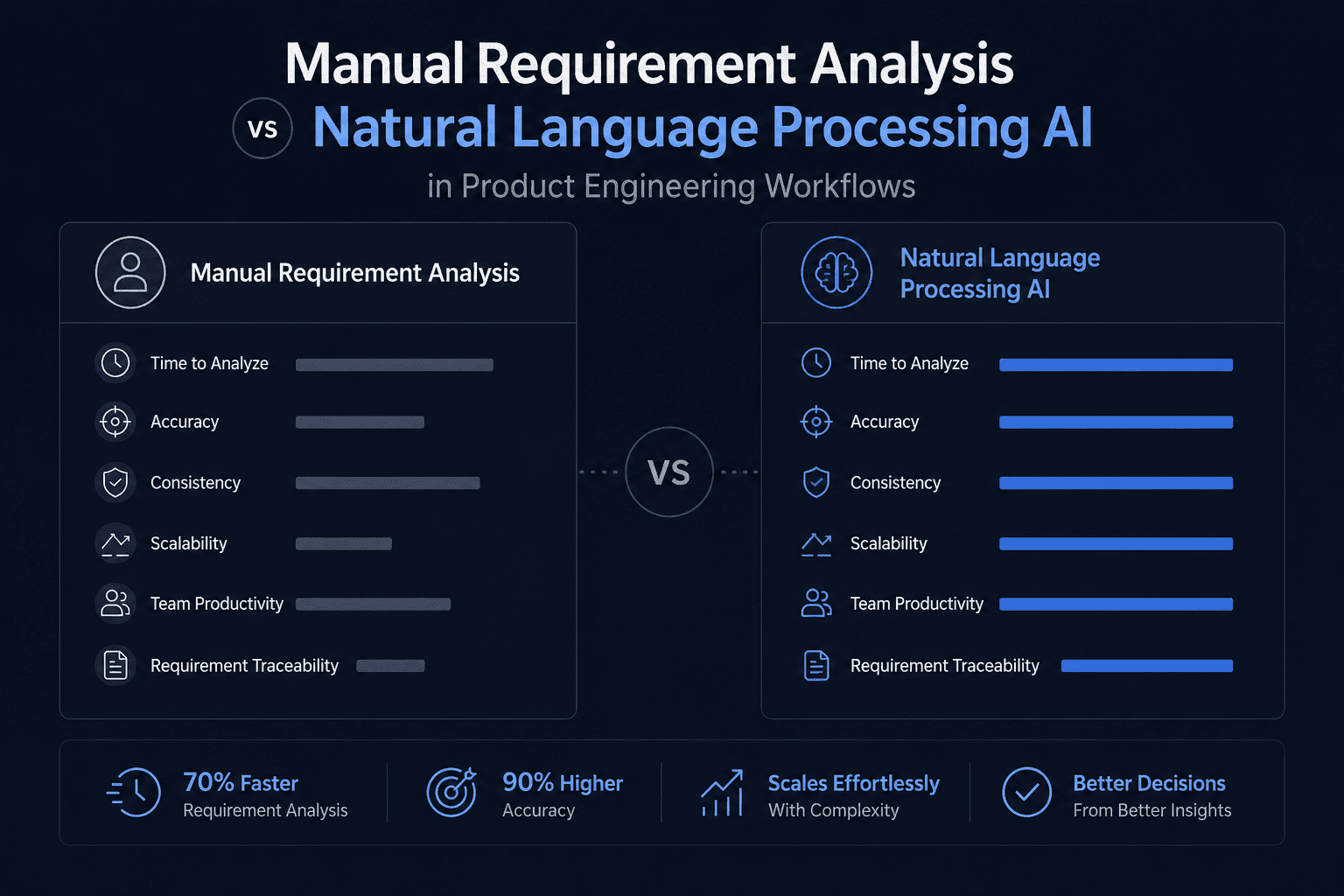
Manual Requirement Analysis vs Natural Language Processing AI in Product Engineering Workflows
Product engineering has always depended on accurate requirement gathering and analysis. Every successful software product begins with a clear understanding of business objectives, user expectations, technical constraints, and functional needs. As organizations continue to build increasingly complex digital products, natural language processing ai is emerging as a powerful technology that is changing how requirements are interpreted, analyzed, and transformed into development-ready insights.
Traditionally, requirement analysis has been a manual process involving stakeholder meetings, documentation reviews, workshops, and extensive communication between business and technical teams. While this approach has delivered results for decades, modern organizations increasingly rely on advanced automation and natural language processing services to improve efficiency, reduce ambiguity, and accelerate decision-making across product engineering workflows.
Understanding Manual Requirement Analysis
Manual requirement analysis is the process of collecting, documenting, validating, and refining product requirements through human effort. Business analysts, product managers, solution architects, and stakeholders work together to identify what a product should accomplish before development begins.
The process generally involves reviewing business documents, conducting interviews, gathering user feedback, analyzing market demands, and creating requirement specifications. Analysts then translate business language into structured requirements that development teams can implement.
Manual analysis offers several advantages:
- Deep contextual understanding of business objectives
- Better handling of complex organizational nuances
- Strong stakeholder collaboration
- Human judgment in interpreting uncertain requirements
However, as projects grow larger, manual processes become increasingly difficult to manage. Hundreds of requirement documents, emails, meeting notes, support tickets, and user feedback reports can create significant challenges for teams attempting to maintain consistency and accuracy.
The Growing Complexity of Product Engineering
Modern product engineering environments operate at a scale that was uncommon just a decade ago. Organizations continuously collect information from multiple channels, including customer interactions, internal communications, product feedback systems, and market research initiatives.
This creates a vast amount of unstructured data that must be analyzed before meaningful product decisions can be made. Human analysts often spend considerable time reading, categorizing, and interpreting information before identifying actionable requirements.
As development cycles become shorter and customer expectations increase, organizations need faster methods for converting raw information into usable engineering insights. This demand has accelerated the adoption of AI-powered requirement analysis technologies.
How Natural Language Processing AI Changes Requirement Analysis
Natural Language Processing AI for Requirement Understanding
Natural language processing ai enables systems to understand, interpret, categorize, and extract meaning from human language. In product engineering, this capability allows organizations to process large volumes of requirement-related information automatically.
Instead of manually reviewing every document, AI systems can analyze stakeholder communications, customer feedback, business specifications, and support requests to identify recurring themes, functional requirements, risks, and priorities.
These systems can detect relationships between requirements, identify inconsistencies, highlight missing information, and surface patterns that might otherwise remain unnoticed. As a result, teams gain access to insights much faster than traditional manual methods allow.
The ability to process thousands of text-based records in a short period creates a significant advantage for organizations managing large-scale product development initiatives.
Comparing Manual and AI-Driven Requirement Analysis
Although both approaches aim to improve requirement quality, they differ significantly in execution and outcomes.
Speed
Manual analysis often requires extensive review cycles involving multiple stakeholders. Large projects may take weeks or months to complete requirement validation activities.
AI-driven systems can process large datasets in minutes, enabling faster requirement discovery and prioritization.
Scalability
Human analysts face limitations when handling growing volumes of documentation. As project complexity increases, maintaining consistency becomes more difficult.
AI systems scale more effectively because they can continuously analyze large quantities of information without experiencing fatigue or inconsistency.
Accuracy and Consistency
Manual analysis can be affected by interpretation differences among team members. Two analysts may derive different conclusions from the same document.
AI models apply consistent evaluation criteria across all documents, helping reduce variation and improving standardization throughout the workflow.
Contextual Judgment
Despite technological advancements, human expertise remains essential. Analysts understand organizational culture, strategic objectives, and business realities that may not be fully represented in documentation.
For this reason, the most effective organizations combine human expertise with AI-powered analysis rather than replacing analysts entirely.
Benefits of AI-Assisted Product Engineering Workflows
The integration of AI into requirement analysis creates benefits that extend beyond documentation management.
First, teams can identify requirement gaps much earlier in the development lifecycle. Early detection reduces the likelihood of expensive redesigns and project delays.
Second, AI improves traceability. Organizations can connect requirements to stakeholder inputs, customer feedback, and business objectives more effectively, creating greater transparency throughout development.
Third, intelligent systems help prioritize requirements based on business impact, user demand, and implementation complexity. Some organizations combine requirement intelligence with predictive analytics to estimate potential outcomes before development begins.
These advantages support faster decision-making while improving overall product quality.
The Rise of Intelligent Engineering Systems
Product engineering is increasingly moving toward intelligent automation. Advanced platforms can now assist with requirement classification, impact analysis, risk identification, and recommendation generation.
A notable trend involves the adoption of Agentic AI, where systems perform goal-oriented tasks with greater autonomy. Instead of merely processing information, these systems can recommend actions, suggest requirement improvements, and support strategic planning activities.
This evolution represents a shift from simple automation toward intelligent collaboration between human experts and AI-powered systems.
Challenges of Implementing AI in Requirement Analysis
Despite its advantages, AI adoption introduces several challenges.
One major concern involves data quality. AI systems depend heavily on the information they receive. Poorly written requirements, inconsistent documentation, or incomplete datasets can affect output quality.
Organizations must also address governance and validation requirements. Product decisions should not rely solely on automated recommendations. Human oversight remains critical for ensuring business alignment and regulatory compliance.
Another challenge is change management. Teams accustomed to traditional workflows may require training and process adjustments before fully benefiting from AI-assisted analysis.
Successful implementation depends on balancing technological capabilities with established engineering practices.
Impact on Modern Software Delivery
The influence of AI-powered requirement analysis extends throughout the software development lifecycle. Better requirements lead to improved design decisions, more accurate development estimates, and higher-quality testing processes.
Organizations engaged in web and application development particularly benefit from faster requirement discovery because digital products often evolve rapidly based on customer feedback and market conditions.
By improving requirement quality at the beginning of the lifecycle, teams reduce downstream inefficiencies and improve delivery outcomes.
Finding the Right Balance Between Humans and AI
The future of requirement analysis is unlikely to be fully manual or fully automated. Instead, organizations are moving toward hybrid workflows that combine the strengths of both approaches.
Human analysts provide strategic thinking, contextual understanding, stakeholder management, and business judgment. AI contributes speed, scalability, consistency, and advanced data processing capabilities.
Together, these capabilities create a more effective product engineering environment capable of handling modern development complexity while maintaining high-quality decision-making standards.
Conclusion
As digital products become more sophisticated, requirement analysis must evolve to keep pace with growing volumes of information and increasing development demands. While manual analysis continues to offer valuable business context and stakeholder insight, AI-powered approaches provide unprecedented efficiency and scalability. Organizations that successfully combine human expertise with natural language processing ai can improve requirement quality, accelerate product delivery, and make more informed engineering decisions. The future of product engineering workflows will not be defined by choosing between people and technology, but by creating intelligent collaboration models where natural language processing ai enhances the strengths of experienced professionals.